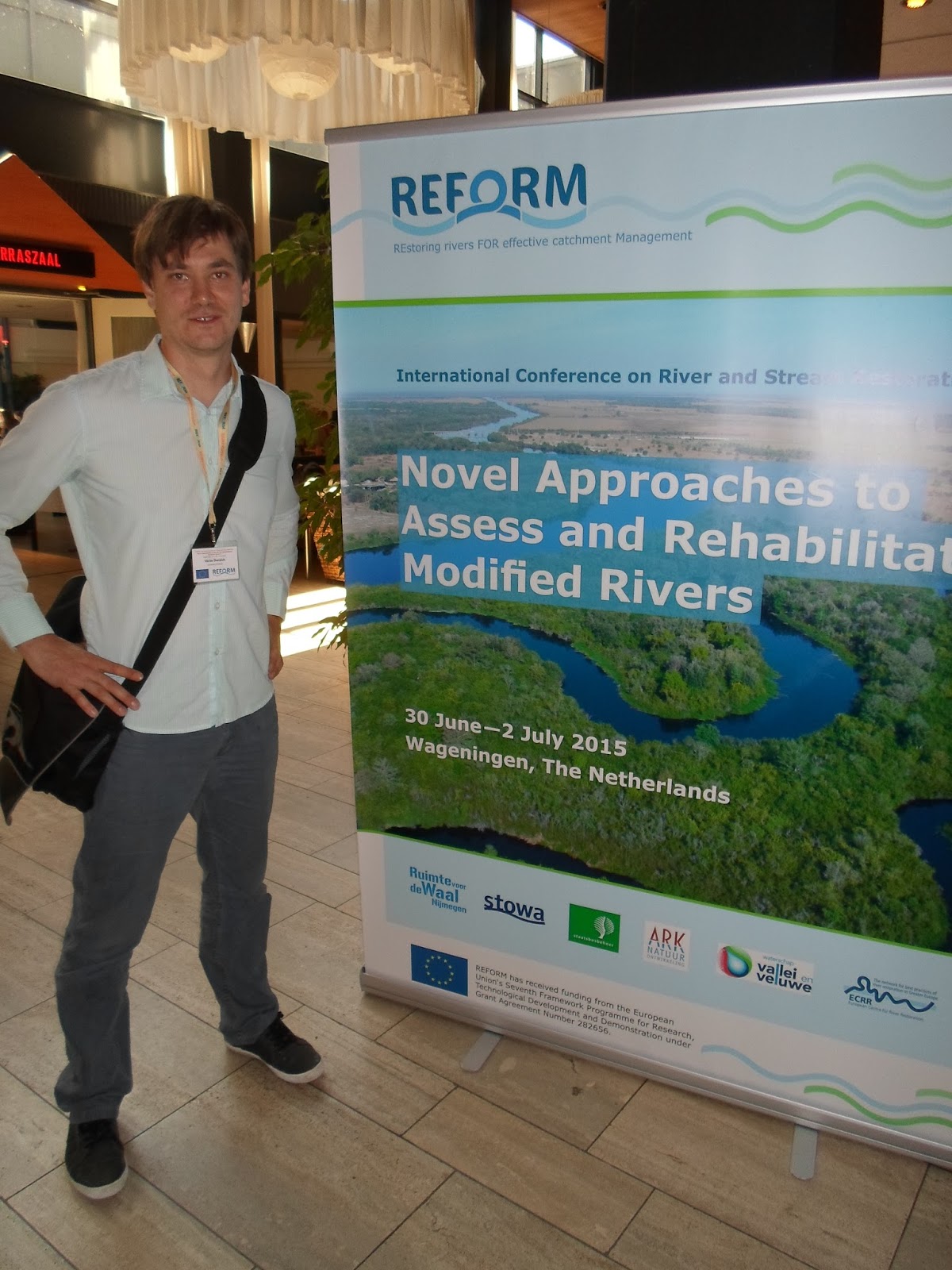
Thursday, 2 July 2015

REFORM: International Conference, 2015 (Wageningen, Netherlands)


We were involved in 'Novel Approaches to Assess and Rehabilitate Modified Rivers' an international conference on river and stream restoration. Conference followed REFORM - Summer School (see report - link). Main scope and objectives of the conference was to enlarge awareness of the need and appreciation for the benefits of river rehabilitation.
Members of CZECH-RIVERS, Dr. Tomáš Galia and Dr. Václav Škarpich presented information about river restoration projects and monitoring in Czech part of the flysch Carpathians. Namely about: (i) Morávka River channel widening and (ii) Kněhyně torrent restoration project where we involved in the research monitoring.

Time schedule and basic description of presented contributions:
Anti-erosive construction in the Morávka River – problematic approach to management of flysch Carpathian rivers, Czech Republic 
Authors: Václav Škarpich, Tomáš Galia, Jan Hradecký, Radek Dušek
June 30, 2015 (17:45 p.m to 19:15 p.m.) - poster presentation

During the last century the Morávka River channel has been transformed from anabranching to single channel river pattern that incised as deep as into the bedrock. These changes have been caused by a strong and inappropriate management (as a bank stabilising, weir and valley dam constructing). Contemporary channel changes have not been evident at reach r. km 7.0 to 10.5 which has partly preserved the original anabranching river pattern with lateral erosion. In order to preserve this anabranching channel reach and the prevention of proceeding backward erosion and protection against destruction Vyšní Lhoty weir at r. km 11.3 anti-erosion construction of local channel widening was constructed at r. km 10.7. However, spring flood in year 2010 accelerated present erosive processes and channel incision to the bedrock and showed that the antierosive construction was not well designed. In some parts, the original river bed has lowered by as many as 2.5 m. The anti-erosion construction itself has also been affected by massive incision. This paper summarizes results of monitoring, processes and function of anti-erosion construction of local channel widening with connection to bad management of Water Authorities in Czech Part of the flysch Carpathian Mts and discuss the problematic management solution of destabilized channel reach and gives proposition of the future management.

Torrent restorations in the flysch mid-mountain environment: The case study of the Kněhyně Torrent, Czech Republic 
Authors: Tomáš Galia, Václav Škarpich, Jan Hradecký
July 1, 2015 (11:30 a.m. to 11:45 a.m.) - oral presentation


The occurrence of channel-reach morphologies (e.g., bedrock channels, step-pools, anabranching channels) in mountainous landscape is driven by several internal and external time- and space-variable factors. Especially, the identification of the sediment supply potential related to transport capacity is crucial for later stream management in torrential mountain channels. The contribution deals with theoretical aspects of stream restorations of this part of fluvial net with emphasis on the flysch Western Carpathians on the example of restored anabranching channel-reach of the Kněhyně Torrent. This channel-reach was partly renaturalized by the 100y flood event in 1997, when the single riprap-regulated channel was transformed into anabranching pattern with relatively large gravel deposits. Stabilization elements were added into the channel to preserve that morphology during the restoration project realized in 2003-2004. The field geomorphological mapping shows, that longitudinal disconnectivity in the form of checkdams exists in the stream longitudinal profile and recent potential sediment sources are limited at the watershed scale. These facts make difficult the sustainable preservation of the transport-limited conditions in the Kněhyně. We suppose, that the original anabranching pattern noticed by the 2nd Military survey (half of the 19th century) was resulted from the higher sediment supply caused by different land-use of mountain region and the important role was played by the sediment delivery driven by debris flows under suitable climatic conditions during the LIA. The role of potential sediment supply estimations, bedload transport modelling and dendrogeomorphological approach is discussed in order to better asses relationship between the sediment supply, transport capacity and resulted channel-reach morphology.


Wednesday, 1 July 2015

Participation to the 'Landscapes and Landforms of the Czech Republic' publication (Springer)

Source of picture: <http://www.springer.com/>
Landscapes and Landforms of the Czech Republic publication (book) is to present the unique geomorphic landscapes of the Czech Republic. It will be published by Springer - as a series of World Geomorphological Lanscapes (see link for more information). Assoc. Prof. Dr. Jan Hradecký and Dr. Václav Škarpich participate to chapter with name: Poodří - Landscape of Ponds and a Preserved Meandering Belt of the Odra River (Authors: Jan Hradecký – Radek Dušek - Marián Velešík – Monika Chudaničová - Václav Škarpich – Radim Jarošek – Jan Lipina). Chapter describes the Poodří Region as a territory of precious natural values that have been created by fluvial processes and also by man who started to participate in the landscape development in the Middle Ages.

Monday, 29 June 2015

Report from REFORM Summer School (Wageningen, Netherlands)

Dr. Tomáš Galia and Dr. Václav Škarpich participated to Summer School 'Restoring Regulated Streams linking Theory and Practice' (link). It was organized by REFORM (REstoring rivers FOR effective catchment Management - see link). The Summer School was realized for 3-day programme from June 27 to June 29, 2015. 

Day 1st (June 27, 2015) started with an introduction and field visit of two contrasting stream restoration, namely: (i) Restoration programme Leuvenumse and Hiederse Beek, (ii) Stream restoration project Lunterse Beek.

 Fig. 1: Floodplain reconnection (for fish population - reconnection to spawning area) - Leuvenumse and Hiederse Beek.

Fig. 2: Feeding-sand (sand suppletion into the river channel) - Leuvenumse and Hiederse Beek.

 Fig. 3: Accumulated sand from feeding-sand (man affected sand suppletion) - Leuvenumse and Hiederse Beek.

 Fig. 4: Addition of wood into the river channel system - Leuvenumse and Hiederse Beek.

 Fig. 5: Addition of wood into the river channel system - Leuvenumse and Hiederse Beek.

 Fig. 6: Stream restoration of the Lunterse Beek.

 
Day 2nd (June 28, 2015) offered the theoretical background of assessing hydromorphological modification of streams and rivers and identifying appropriate restoration measures considering the socioeconomic context. The main topics were presented by: Prof. Ian Cowx, Prof. Angela Gurnell, Prof. Massimo Rinaldi, Dr Christian Wolter, Dr Nikolai Friberg, Dr Jochem Kail and  Dr Gertjan Geerling (see link to lectures video).

Fig. 7: First lecture about 'Planning Stream and River Restoration and Cost-
Benefit Analysis' performed by Prof. Ian Cowx.

 
Day 3rd (June 29, 2015) was be given a case study and work in groups to plan of restoration schemes based on the practices from previous field visit and theoretical background from lectures. The day was finished by presenting of restoration scheme by each group.

Saturday, 7 March 2015

Significance of the coarsest bed fraction in flysch headwater streams

Boulders in steep headwater streams play an irreplaceable role in hydraulics, sediment transport and bed stability within this part of fluvial net. A few months ago, our new publication  has been released in Geografiska Annaler: Series A, Physical geography dealling with the connectivity of the coarsest fraction in Beskydian steep streams. Also, effects of past disturbances (debris-flows) and present lateral sediment supply was discussed in this paper. Debris-flow affected channels indicated more frequent occurrence of larger boulders in bed sediments and limited adjustments to contemporary fluvial processes (e.g. incision). On the other hand, bed sediments in channels void of past debris-flow activity often reflected lateral sediment inputs (e.g. bank failures) and trends of erosion or deposition. This study directly followed our previous paper published in Moravian Geographical Reports, which described downstream trends of coarse bed sediments and clustering of bed sediments reflecting recent fluvial processes in one of headwater stream. Other paper discussing bedload transport of the coarsest bed fraction in relation to recent geometrical parameters of steep channels and transformation of channel-reach morphology during bankfull and high-magnitude discharge is in review. The study will summarize our bedload transport observations (Q20 flood 2010, bankfull event 2011, Q5 flood 2014), contemporary fluvial processes (incision, aggradation) and connectivity of boulder and cobble fraction in local steep channels.   


Sunday, 21 December 2014

Sediment Matters (Springer)

Source of picture: <http://www.springer.com/>
New book will be published by Springer - a global publishing company. Book with title Sediment Matters (link) was edited by Peter Heininger and Johannes Cullman. Book presents insights into the complex processes controlling sediment behavior in river basins and into state of the art integrated sediment management concepts.

We participate to chapters:
  • Sediment transport in headwater streams of the Carpathian Flysch belt: its nature and recent effects of human interventions.
  • Aspects of sediment transport in single-thread and anabranching river channels in flysch Carpathians (a case study from the Czech Republic).


New Czech Science Foundation (GACR) Project

Assoc. Prof. RNDr. Jan Hradecký, Ph.D. and RNDr. Václav Škarpich, Ph.D. are members of research team for realization of project - GAČR: 15-02067S (2015-2017) – Optimalization of dendrogeomorphic methods in landslide research. Project will be realized during the years 2015 – 2017. Research will focused to defining optimal spatial position and number of trees for field sampling, determining optimal age/size of trees that most sensitively reflect landslide movements and increasing the efficiency of landslide signal extraction from tree-rings. 
Source of picture: http://www.gacr.cz/en/


Thursday, 16 October 2014

A complex approach for evaluation of sediment (un)balance in a steep headwater channel

A new paper was published in Catena, where a dendrogeomorphic approach was combined with ERT sounding and bedload transport simulations to estimate sediment budget during high-magnitude flood in a steep channel. It has been resulted from the cooperation with the dendrogeomorphic section of the Department of physical geography and geoecology, University of Ostrava. The methodology and results of this research were also presented on the Conference of Association of Slovac geomorphologists in Snina in October 2014. 

Sediment (un)balance budget in a high-gradient stream on flysch bedrock: A case study using dendrogeomorphic methods and bedload transport simulation
Detailed quantification of material supply into stream channels is crucial for determining sediment (un)balance budget during flood events. Unfortunately, existing quantification methods require long-term field monitoring; otherwise, there is an insufficient amount of usable data. In this study, we introduce a new approach, based on dendrogeomorphic methods, to determine the volume of material supply generated from flysch high-gradient stream bank failures. This approach was supplemented by 1D sediment transport modelling, using a TOMSED model.
We analysed 138 cross-sections from the roots of predominantly broad-leaved trees, which were exposed in bank failures from different floods. Using the spatial position of the roots and dating the exposure time, we determined the volume of material supply into the channel during the last flood, in 2010. In-channel sediment transport was analysed on 14 cross-sections, and the channel sediment thickness was estimated using the geophysically based ERT (Electrical Resistivity Tomography) method.
The total volume of material loss during the 2010 flood within the study area, according to the TOMSED model, was found to be at least 300 m3. This means that the calculated total volume of sediment supply resulting frombank failures during the flood (63.9 m3 based on dendrogeomorphic methods) was significantly lower than the calculated bedload transport for the entire study area. This finding implies that contemporary sediment sourcescannot adequately cover the transport capacity during high-magnitude flood events, and in general, in-channel erosion processes prevail.