Our fluvial
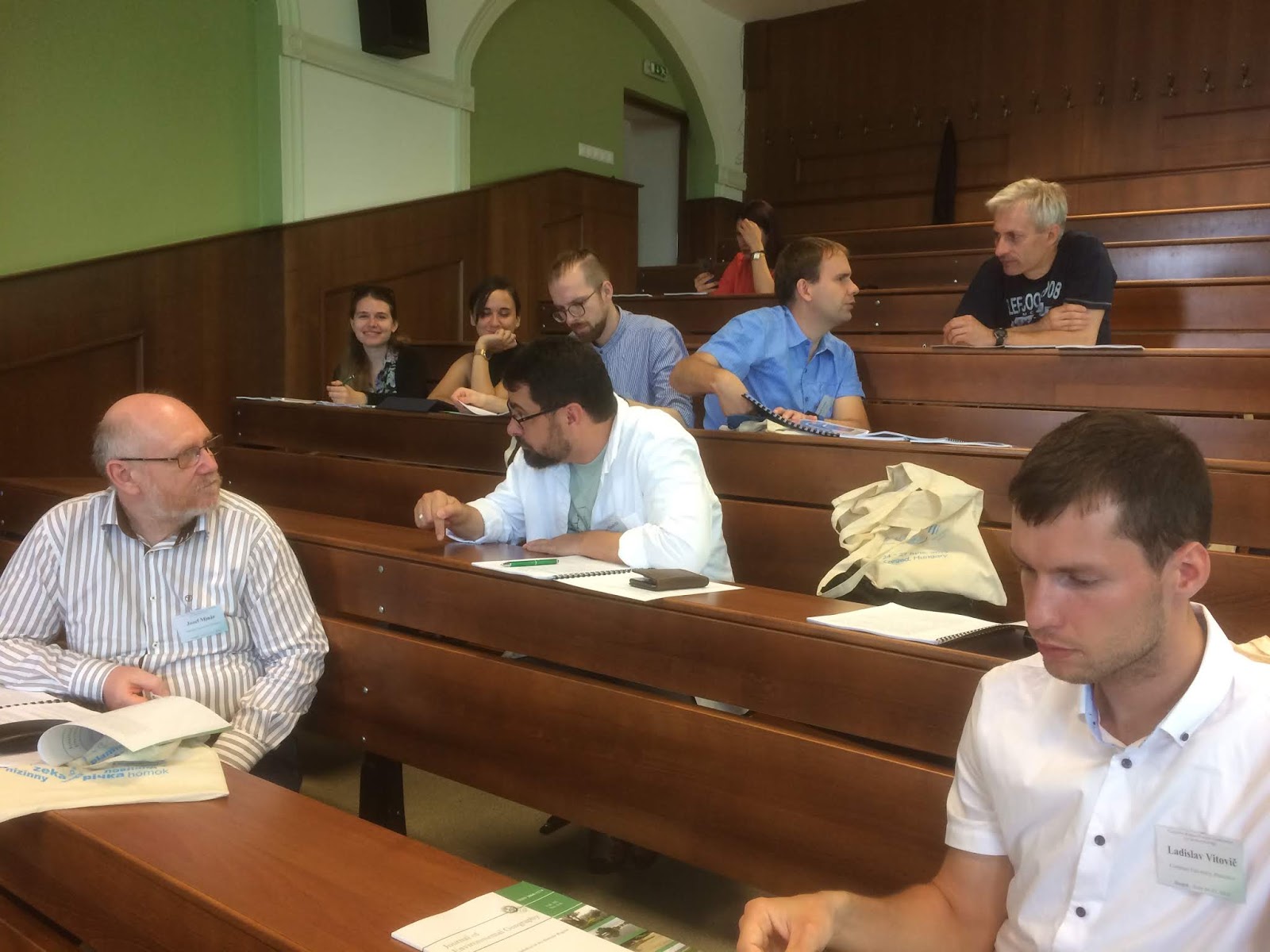
group presented research on Carpatho-Balkan-Dinaric Conference on
Geomorphology. The Conference was held from June 24 to 27, 2019 at Szeged in Hungary.
It was focused on rapidly changing world, various environmental hazards which cause
considerable damages and loss of life, or their consequences change the rate of
geomorphological processes and forms in the Carpatho-Balkan-Dinaric Region. We
participated in sessions which were focused on problematics linked with human
impact on fluvial processes and systems. Our contributions were dealing with Morphological response of mountain streams
to long-term human interventions in the Czech Carpathians presented by
Tomas Galia, Fluvial system diversity in
relation to confluence hydrodynamic zone – a review study by Lukáš Vaverka,
Morphological effects of long-term low
sediment inputs – the Elbe River by Jan Hradecký, Public perception of gravel bed rivers. A case study from the Czech
Carpathians by Zuzana Poledniková, Possibilities
for stopping of further degradation gravel-bed Morávka River by Tereza
Macurová, and Conceptual framework for
restoration of Czech Carpathian Rivers by Václav Škarpich.
Wednesday, 3 July 2019
Thursday, 25 April 2019
Check dams decrease the channel complexity of intermediate reaches in the Western Carpathians
Our new article published in Science of the Total Environment focuses on potential degradation of mountain channels affected by direct human interventions. We dealt with four channel complexity dimensions (longitudinal, cross-sectional, large wood and bed sediments) of foothill and steep streams treated by check dams. We observed that check dams altered the channel complexity of intermediate reaches (i.e., reaches between subsequent check dams) when compared with reaches of undisturbed streams. A higher degradation was typical for a foothill unconfined stream (S = 0.01-0.02 m/m), where this stream completely lost its vertical bed oscillations because of the transformation of pool-riffles to a uniform plane bed morphology. On the other hand, a steep stream (S = 0.06-0.12 m/m) indicated an increase in sediment homogeneity when compared to an untreated stream, but this management did not heavily affect longitudinal or cross-sectional heterogeneity. Due to the presence of managed riparian corridors, we did not observe differences in instream wood abundance between treated and untreated streams.
Galia, T., Škarpich, V. Ruman, S., Macurová, T. (2019): Check dams decrease the channel complexity of intermediate reaches in the Western Carpathians (Czech Republic). Science of the Total Environment 662, 881-894. doi: 10.1016/j.scitotenv.2019.01.305
Tuesday, 16 April 2019
Participation on the traditional conference of Czech Association of Geomorphologists
We participated on the traditional conference of Czech Association of Geomorphologists. 19th International Conference "State of
geomorphological research in 2019", this year titled „Český ráj ´19” was
held in the Bohemian Paradise in Parkhotel Skalní Město near Jičín from 3rd to 5th
April 2019. It was organized by the Institute of Rock Structure and Mechanics
of the CAS, in cooperation with Bohemian Paradise Geopark.
The conference venue was situated in the geomorphologically
attractive area of Bohemian Paradise, near the famous Prachovské skály rock
labyrinth. This unique area, formed by sandstone plateaus of Bohemian
Cretaceous basin and dominant landmarks of Tertiary neovolcanic intrusions,
offers some of the most spectacular landforms.
We participated with oral and poster presentations with
focus on problematics of check dams in mountain streams and their effect on channel
complexity, effect of instream wood on fluvial processes in the Odra River, perspectives
of gravel bars in the sense of planned lock chamber construction in the lower
Elbe River, a confluence hydrodynamic zone as integral part of fluvial system
diversity and mapping geomorphic (dis)connectivity in the human modified
landscape of the Slavíč River valley in the Moravskoslezské Beskydy Mts.
Proceedings were published (here).
Friday, 23 November 2018
Our research of instream wood in Mediterranean environment
This year, we continued with investigations of the abundance and geomorphic effect of instream wood in Mediterranean fluvial systems. In June, we again visited the Lefka Mts (the highest mountain range in Crete, Greece) to assess predictors of instream wood loads in intermittent and ephemeral streams draining this mountain range. We measured parameters of wood together with channel geometry and riparian forest characteristics in ca. 40 channel reaches. The preliminary results show that the frequency of instream wood has rather a random character, whereas the biomass in riparian forests is important for instream wood volumes in small Mediterranean channels.
![]() |
| Wood deposited by a previous flood outside the bankfull channel. |
![]() |
| Step consisted of instream wood acting as sediment retention element. |
During late September, we also investigated characteristics of instream wood in larger intermittent river (the Evrotas) draining the Peloponnese peninsula. Together with colleagues from Hellenic Center of Marine Research (Dr. Vardakas, Prof. Kalogianni) we also tried to find connections between the occurrence of instream wood and local endemic fish species. The examined river is interesting by alterations of hydrologic (dry vs. wet channels) and geomorphic (single thread vs. wandering) patterns. These alterations are reflected in the abundance of instream wood together with the character of riparian trees and occasional removal of instream wood by local people.
![]() |
| Instream wood in a single-thread wet reach. |
![]() |
| The stump transported by a previous flood into dry wandering channel. |
Now we are processing field data from both studied areas and we are planning to prepare related scientific articles during the first moths of 2019.
Monday, 12 November 2018
Field excursion about river restoration projects in Upper and Lower Austria
The field excursion
trip took place for students of our Department of Physical Geography and
Geoecology from 5 to 8th September 2018. The main idea was showing river
restoration projects in Lower and Upper Austria, namely on the Danube River and
its tributaries, e.g. on the Traun River or the Ybbs River.
On Tuesday
6th of September, the first day of field excursion trip was focused on river
restoration projects in urban area of Linz City. Especially, on the restoration
of gravel bars on the left-side bank of the Danube River and future vision of
river restoration of Danube River, e.g. creating of islands and side-channels
in Urfahr District.
The second
day of excursion was focused on the river restoration projects in downstream
part of the Ybbs River. We visited reaches between Greinsfurth and Winklarn
villages where river restoration were realized, e.g. fishpass through
Greinsfurth hydropower dam (or weir), distributary of the Ybbs River near
Winklarn for increasing of biodiversity and heterogeneity of channel, or
restoration of mouth of the Ybbs River to the Danube River.
The third
day, we visited hydropower dam in Melk with lock chamber for river navigation on
the Danube River. The last stop was close-to-natural fishpass through
hydropower dam in Melk.
| Restored gravel bars on the left-side bank of the Danube River in Linz. |
| Fishpass through Greinsfurth hydropower dam. |
| Greinsfurth hydropower dam. |
| Presentation of river restoration of distributary near Winklarn. |
| Crossing through the restored reach Ybbs River near Winklarn. |
| On the hydropower dam in Melk. |
Field Excursion was supported by Moravian-Silesian Region
Subscribe to:
Posts (Atom)


