Wednesday, 24 October 2018

Effect of hydraulics of regulated and re-naturalized channels on grain-size parameters


With co-operation with our colleague Assoc. Prof. Dr. Zdeněk Máčka from Masaryk University, we published article about effect of hydraulics of regulated and re-naturalized channels on grain-size parameters in Science of the Total Environment multidisciplinary journal.


The grain-size characteristics obtained on 68 gravel bars were confronted with modelled flow hydraulics and information obtained by fluvial-geomorphic mapping along 14.0-km river reach of the Bečva River (Outer Western Carpathian Mts., Czech Republic). The studied channel reach is presently characterized by several distinctive sections: for a long time (ca. 100 years) regulated single channel sections with artificial bank stabilizations incised several meters in the floodplain and by contrast, multi-thread channel patterns of two sections, which have witnessed retrograde development after large floods in 1997 and 2010.
The mapping of sediment (dis)connectivity brought important findings about the character of sediment flux in the studied reach, which were confronted with simulated cross-sectional hydraulics. We demonstrated that in the case of a high occurrence of lateral sediment inputs (tributaries, bank failures) and longitudinal sediment flux disconnectivities (weirs or boulder ramps), the assessment of the longitudinal distance, bar grain size and simulated hydraulics submerging bars did not produce any clear relationships. Although the sections with re-naturalized multi-thread patterns showed distinctive hydraulic variables (i.e., larger wetted width or lower unit stream power), we did not observe direct relationships with their bar sediment sizes. This implies that for complex fluvial systems of multi-thread rivers as the transition reaches connecting mountainous and lowland areas, even those in unconfined valley settings out of the primary sediment sources, additional factors (i.e., effect of bank failures and especially tributaries as sediment inputs, weirs or boulder ramps as sediment flux disconnectivities) beyond local flow hydraulics and distance from the main sediment sources contribute to better explanation of the downstream evolution of grain-size patterns.

View of the Bečva River channelized (managed) single channel sections (A, C, E) and retrogradually developed (re-naturalized) multi-thread channel sections (B, D).

Wednesday, 3 October 2018

River Flow 2018 - Ninth International Conference on Fluvial Hydraulics


We participated on the River Flow 2018 - Ninth International Conference on Fluvial Hydraulics. Conference was held from 5 to 8th September 2018 in Lyon-Villeurbanne (France). It was organized by the IAHR Committee on Fluvial Hydraulics. River Flow Conference is one of the major international conference in river engineering and fluvial hydraulics since 2002. Conference is focused on the latest findings in the field of fluvial hydraulics, addressing fundamental issues related to fluid processes of sediments and pollutants in rivers and practical issues related to river morphodynamics, river restoration, and river interaction with structures.
We participated with oral presentations with focus on problematics of large wood occurence and mobility in contrast (e.g. of Medirranean or Temperate) mountain streams in Europe and problematic of Carpathian river channels transformation and its effect on ecosystems and also on human society.
Scopus indexed proceedings were published. The PDF versions of papers are available via link here and here


Tuesday, 3 July 2018

New project about bedload sediment regime of torrent streams in Czech Republic was received


Within the fund program of the State Forest Service (LCR, s.p.) in Czech Republic, project about bedload sediment regime of Czech Republic torrent streams was received. Main members of Czech-Rivers research group, namely assistant professors RNDr. Václav Škarpich, Ph.D., RNDr. Tomáš Galia, Ph.D. and Associate Professor RNDr. Jan Hradecký, Ph.D. from Department of Physical Geography and Geoecology are participating in project which will be realized within cooperation of Masaryk University in Brno and the lead partner Envicons, s.r.o. from Pardubice (Czech Republic).
The main aim of the project will be focused to bedload sediment regime quantification of torrent streams in the area of the Moravskoslezské Beskydy Mts., Hrubý Jeseník Mts., Orlické hory Mts., České středohoří Mts., etc. Target of activity is to bring the outputs to management practice of bedload sediment material in torrential streams managed by the State Forest Service in Czech Republic.

Saturday, 30 June 2018

Ongoing research of instream wood in Carpathian headwater streams

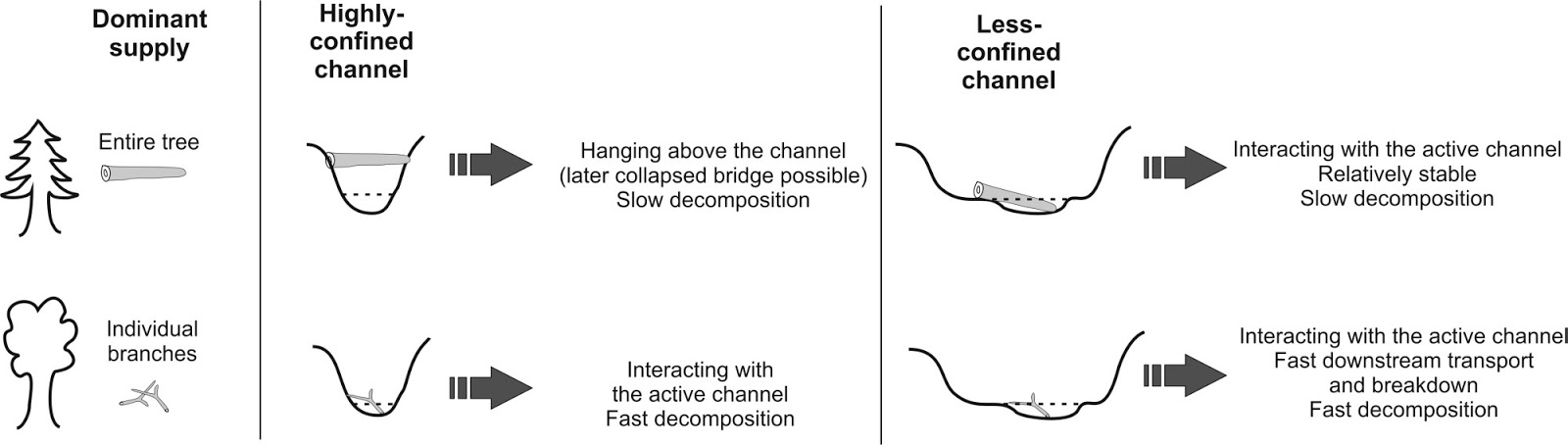
Two our scientific papers were recently published, which deals with instream wood in the headwaters draining the highest peak of the Moravskoslezské Beskydy Mts, Czech part of Western Carpathians. The main aim of the article in Forest Ecology and Management was to find controlling factors of occurrence of large and small wood under mixed forest canopy. Deciduous trees significantly contribute to increasing number of observed small wood due to the recruitment of individual branches from these trees. However, higher frequencies of small wood did not turn into its larger active-channel volumes. On the other hand, conifers were important for the observed frequency of large wood pieces because of (i) recruitment of the whole trees and (ii) longer residence time of local conifers. Additionally, less-confined valley floor also led to increasing frequency of large wood, whereas highly confined valleys are prone to formation of large wood 'bridges' above the zone of bankfull flows. This paper was prepared under cooperation with colleagues from University of Geneve.

Conceptual model of LW and SW abundance and stability based on conifer/deciduous tree species and valley confinement. 


The second paper dealing with steps created by single wood pieces was published by Ecological Engineering. Detailed characteristics of 73 log steps in managed temperate Carpathian forests were assessed together with channel- and wood-based thresholds for log step development. The upstream threshold of log step occurrence can be assigned to those locations in stream longitudinal profiles, where transport capacity during ordinary high flows exceeds the critical value for the initiation of bedload movement (suspended-mode transport is usually not able to form sedimentary wedge upstream individual spanning logs). Downstream thresholds are controlled by stream transport capacity and wood dimensions, which also correspond to the limited recruitment of large wood pieces in local managed forests. The development of a log step at a particular channel width or basin area was controlled by the wood length, but the resultant step parameters (step height and width, length of upstream sedimentary wedge and volume of stored sediments) were better correlated with wood diameter. Nevertheless, the average sediment storage generated by a log step was only 0.51 cubic meters.      
Step created by a single wood piece. 

Empirical model of the potential development of log steps in the studied channels without debris flow or hyperconcentrated flow occurrence. 


Thursday, 28 June 2018

State of the geomorphologic research in 2018

Between 25th and 27th of April 2018, we participated on the 18th conference of Czech Association of Geomorphologists. The traditional State of the geomorphologic research in 2018 conference was held in Vílanec in the hearth of the Czech Republic close to the Vysočina Geopark. The Vysočina Geopark is spread out in the landscape of Bohemian-Moravian Highland. We presented our results from ephemeral channels of semi-arid European Mediterranean mountainous landscape in Crete (Greece) and from basins of the Outer Western Carpathians (OWC) in Czech Republic. Dr. Tomáš Galia discussed the importance of large wood in the geomorphic functions of rivers and streams of an ephemeral channel typical of semi-arid European Mediterranean mountainous landscape (Sfakiano Gorge, Crete, Greece). The conference was the first occasion to present the results of research of barchelor student Tereza Matušková from our Department of Physical Geography and Geoecology. She presented results about fine wood mobility in the Sučí Stream from the Ondřejník Massif (Podbeskydská pahorkatina Hilly land, OWC). Dr. Václav Škarpich and Mgr. Tereza Macurová referred about problematic of the possibilities of restoration measures to keep and protect the multiple-thread river pattern in the Skalická Morávka National Nature Monument in OWC.
  • Galia T., Škarpich V., Tichavský R., Vardakas L., Šilhán K.: Parameters, longitudinal distribution and dynamics of large wood in a Mediterranean ephemeral stream
  • Matušková T.: Fine wood mobility in the Sučí Stream.
  • Škarpich V., Galia T., Macurová T., Ruman S., Hradecký, J.: Possibilities for sustainability of the multiple-thread Morávka River channel in the Skalická Morávka National Nature Monument.
  • Macurová, T., Škarpich V., Galia T., Ruman S., Hradecký J.:  Gravel-bar dynamics of the protected multiple-thread reach of the Morávka River.
During this year we also plan to visit the conference RiverFlow 2018 in Lyon-Villeurbanne (France) between the 5th and 8th of September 2018.

Tomáš Galia during his presentation

Tereza Matušková during her poster presentation of fine wood mobility in the Sučí Stream

Tereza Macurová during her poster presentation about gravel-bar dynamics of the protected multiple-thread reach of the Morávka River