 |
| Deposited instream wood in the Kallikratis gorge. |

Monday, 23 September 2019
Predictors of low instream wood abundance in Cretan steep streams
Our new paper demonstating the role of low tree density in riparian corridors on low abundance of instream wood in steep nonperennial streams was just published in Water Resources Research. Thus, the paper provides deeper understanding of recruitment and retention procecess of instream wood at the reach scale in vulnerable environment of Mediterranean semiarid landscapes, which was based on our detailled measurements in 37 independent channel reaches in Lefka Ori Mts., Crete, Greece. The parameter of elevation controlled mean annual percipitations, which in turn were reflected in the composition of riparian canopy along the steep mountain streams. It is also interesting that the mobilized wood tended to be stored as individual, dispersed pieces rather than in jams, likely due to overall low instream wood abundance which effectively prevented clustering of wood into large jams.

Thursday, 19 September 2019
The study of river restoration potential of the Černá Ostravice River
Human
interactions with mountain streams in Czech part of the flysch Western
Carpathians has more than 100 years of history. These are represented by
indirect impacts since the 16th century linked with an extensive changes in
land use, and by direct human interventions connected with control works,
check-dam constructions (e.g., due to timber floating, flood protection,
sediment regime control). We finished project which was focused on potential
restoration measures in the Černá Ostravice River basin in Moravskoslezské
Beskydy Mts in Czech Republic. The project was realized in cooperation with the
Union for the Morava River. The study proposes potential measures to improve
hydromorphological and habitat conditions in the lower reach of the Černá
Ostravice River. The main measures were aimed to increase stream connectivity
for aquatic communities or sediment flux, increase morphological heterogeneity
and occurrence of instream wood as element affected better stream habitat
conditions and increase of water retention in floodplain.
 |
| Bank stabilization structures protecting road. |
 |
| Regulated channel (partially due to timber floating). |
 |
| Check-dam controlled longitudinal profile of the channel. |
Wednesday, 3 July 2019
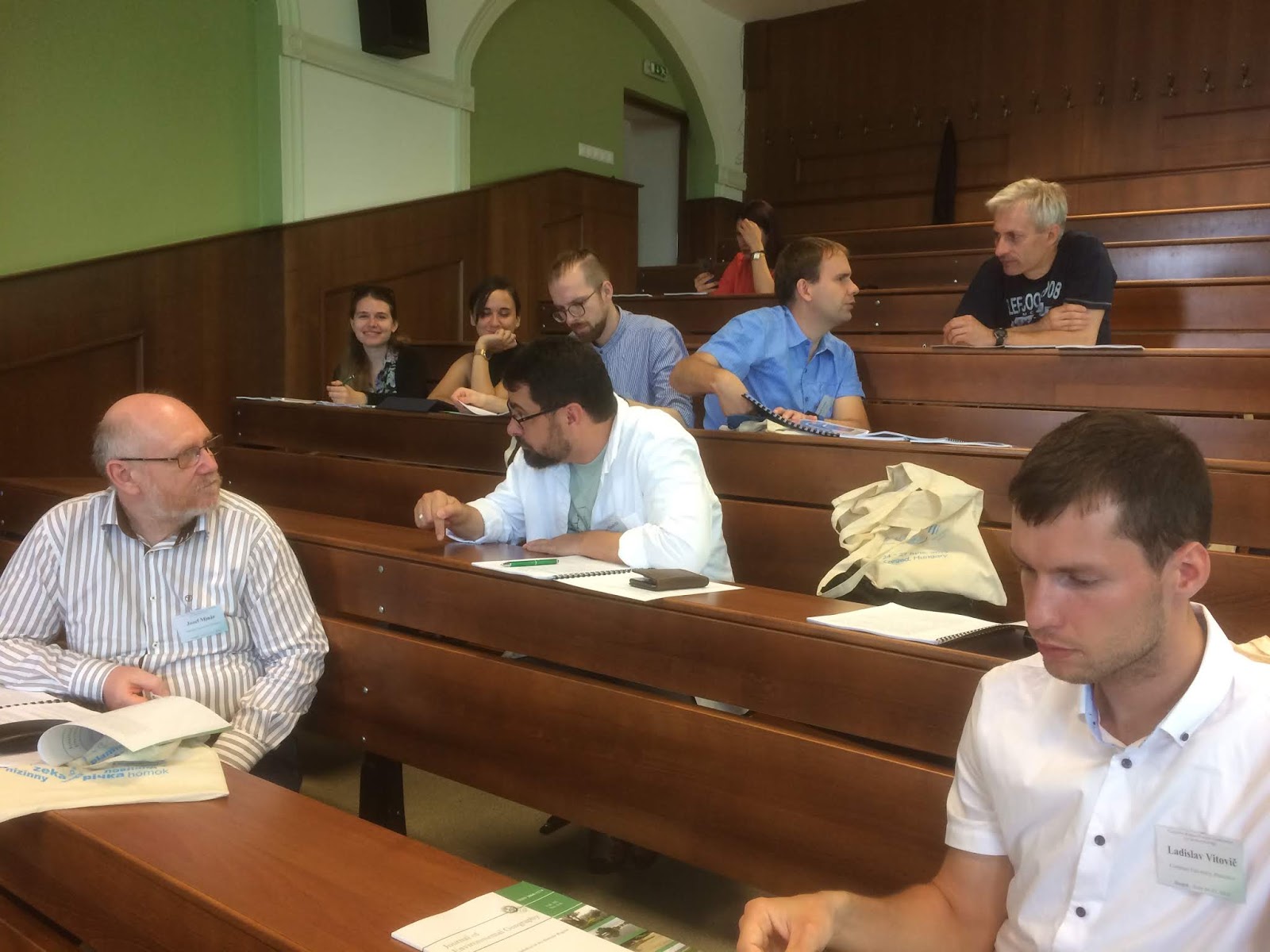
Carpatho-Balkan-Dinaric Conference on Geomorphology
Our fluvial
group presented research on Carpatho-Balkan-Dinaric Conference on
Geomorphology. The Conference was held from June 24 to 27, 2019 at Szeged in Hungary.
It was focused on rapidly changing world, various environmental hazards which cause
considerable damages and loss of life, or their consequences change the rate of
geomorphological processes and forms in the Carpatho-Balkan-Dinaric Region. We
participated in sessions which were focused on problematics linked with human
impact on fluvial processes and systems. Our contributions were dealing with Morphological response of mountain streams
to long-term human interventions in the Czech Carpathians presented by
Tomas Galia, Fluvial system diversity in
relation to confluence hydrodynamic zone – a review study by Lukáš Vaverka,
Morphological effects of long-term low
sediment inputs – the Elbe River by Jan Hradecký, Public perception of gravel bed rivers. A case study from the Czech
Carpathians by Zuzana Poledniková, Possibilities
for stopping of further degradation gravel-bed Morávka River by Tereza
Macurová, and Conceptual framework for
restoration of Czech Carpathian Rivers by Václav Škarpich.


Thursday, 25 April 2019
Check dams decrease the channel complexity of intermediate reaches in the Western Carpathians
Our new article published in Science of the Total Environment focuses on potential degradation of mountain channels affected by direct human interventions. We dealt with four channel complexity dimensions (longitudinal, cross-sectional, large wood and bed sediments) of foothill and steep streams treated by check dams. We observed that check dams altered the channel complexity of intermediate reaches (i.e., reaches between subsequent check dams) when compared with reaches of undisturbed streams. A higher degradation was typical for a foothill unconfined stream (S = 0.01-0.02 m/m), where this stream completely lost its vertical bed oscillations because of the transformation of pool-riffles to a uniform plane bed morphology. On the other hand, a steep stream (S = 0.06-0.12 m/m) indicated an increase in sediment homogeneity when compared to an untreated stream, but this management did not heavily affect longitudinal or cross-sectional heterogeneity. Due to the presence of managed riparian corridors, we did not observe differences in instream wood abundance between treated and untreated streams.

Galia, T., Škarpich, V. Ruman, S., Macurová, T. (2019): Check dams decrease the channel complexity of intermediate reaches in the Western Carpathians (Czech Republic). Science of the Total Environment 662, 881-894. doi: 10.1016/j.scitotenv.2019.01.305
Tuesday, 16 April 2019
Participation on the traditional conference of Czech Association of Geomorphologists
We participated on the traditional conference of Czech Association of Geomorphologists. 19th International Conference "State of
geomorphological research in 2019", this year titled „Český ráj ´19” was
held in the Bohemian Paradise in Parkhotel Skalní Město near Jičín from 3rd to 5th
April 2019. It was organized by the Institute of Rock Structure and Mechanics
of the CAS, in cooperation with Bohemian Paradise Geopark.
The conference venue was situated in the geomorphologically
attractive area of Bohemian Paradise, near the famous Prachovské skály rock
labyrinth. This unique area, formed by sandstone plateaus of Bohemian
Cretaceous basin and dominant landmarks of Tertiary neovolcanic intrusions,
offers some of the most spectacular landforms.
We participated with oral and poster presentations with
focus on problematics of check dams in mountain streams and their effect on channel
complexity, effect of instream wood on fluvial processes in the Odra River, perspectives
of gravel bars in the sense of planned lock chamber construction in the lower
Elbe River, a confluence hydrodynamic zone as integral part of fluvial system
diversity and mapping geomorphic (dis)connectivity in the human modified
landscape of the Slavíč River valley in the Moravskoslezské Beskydy Mts.
Proceedings were published (here).


Subscribe to:
Posts (Atom)